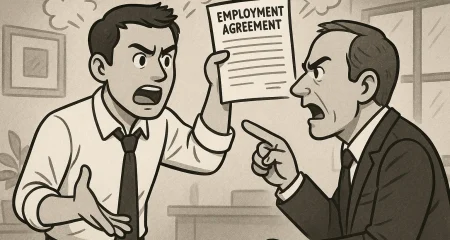
Dutch labour law is the set of rules on the relationship between employer and employee, and most of it cannot be contracted away. The rules in Book 7, Title 10 of the Dutch Civil Code (BW) are largely mandatory: a clause that departs from them to the employee’s disadvantage is void, whatever both parties signed, unless the law itself allows a collective agreement to deviate.
Labour law has four blocks: the individual employment contract (Civil Code), working conditions (Working Hours Act and Working Conditions Act), collective labour law (collective agreements and works councils) and equal treatment law. Disputes go to the subdistrict court (kantonrechter) whatever the amount, and you can appear there without a lawyer.
Sommario
What does the Civil Code require for the employment contract?
The Civil Code sets minimum rules for every employment contract, from the first working day to dismissal. Within one week of the start, the employer must give the essential terms in writing under Article 7:655 BW.

A probationary period is not allowed in a contract of six months or less, and is limited to one month for other fixed-term contracts shorter than two years and two months otherwise (Article 7:652 BW). A non-compete clause requires a written agreement with an adult employee and, in a fixed-term contract, a written statement of the compelling business interests (Article 7:653 BW).
Under the chain rule in Article 7:668a BW, a fourth fixed-term contract, or a series lasting more than 36 months, turns into a permanent contract. The chain is broken only by an interval of more than six months. A collective agreement may deviate from these numbers in some sectors.
The employee is entitled to paid holiday of at least four times the weekly working hours (Article 7:634 BW) and, during illness, to at least 70% of the salary for up to 104 weeks (Article 7:629 BW). The statutory minimum wage is adjusted every 1 January and 1 July. Read more about employment rights in detail.
How does dismissal work in the Netherlands?
An employer cannot dismiss at will: it needs a reasonable ground under Article 7:669 BW and the right route. That route is permission from the UWV (for economic reasons or long-term illness), a decision of the subdistrict court (for other grounds), or the employee’s written consent, usually in a settlement agreement (vaststellingsovereenkomst).
After a dismissal on the employer’s initiative, the employee is usually entitled to a transition payment (transitievergoeding): one third of a monthly salary for every year of service. In 2026 it is capped at €102,000, or one annual salary if that is higher (Article 7:673 BW).
Deadlines are short. A request to the court to annul or challenge a dismissal must generally be filed within two months after the end of the employment, and a request for the transition payment within three months (Article 7:686a(4) BW). An employee who signs a settlement agreement can cancel it within 14 days without giving reasons (Article 7:670b BW).
What do the Working Hours Act and Working Conditions Act require?
The Working Hours Act (Arbeidstijdenwet) limits working time to 12 hours per shift and 60 hours per week, and to an average of 48 hours per week over 16 weeks. Employees are entitled to 11 hours of uninterrupted rest in every 24 hours, which may be reduced to 8 hours once every seven days.
The Working Conditions Act (Arbowet) obliges the employer to provide a safe and healthy workplace, including measures against psychosocial workload such as harassment and work pressure. The employer must have a risk assessment (RI&E) and access to an occupational health and safety service. The Netherlands Labour Authority (Nederlandse Arbeidsinspectie) enforces these rules and can impose fines.
When do collective agreements and works councils apply?
A collective labour agreement (cao) binds an employer that is a member of a signatory employers’ association, or every employer in a sector if the Minister of Social Affairs declares it universally binding. A cao often regulates wages, working hours and the chain rule differently from the Civil Code.
An employer with 50 or more employees must set up a works council (ondernemingsraad) under the Works Councils Act (WOR). The works council has a right of advice on decisions such as a reorganisation or a takeover (Article 25 WOR) and a right of consent on rules such as working hours and pension arrangements (Article 27 WOR).
What does equal treatment law prohibit?
Dutch law prohibits distinction on grounds including sex, age, disability, religion, race, sexual orientation, working hours and the type of contract (fixed-term or permanent). An employee who feels treated unequally can ask the Netherlands Institute for Human Rights (College voor de Rechten van de Mens) for an opinion, which charges no fee, or go to the subdistrict court.

Che cosa dovresti controllare come dipendente?
- Did you receive your essential terms in writing within one week of starting?
- Is the probationary period or non-compete clause valid under Articles 7:652 and 7:653 BW?
- Has your series of fixed-term contracts turned into a permanent contract under the chain rule?
- Does a cao apply to your employer, and does it give you more rights?
- Have you noted the deadlines of two and three months after the end of your employment?
Che cosa dovresti verificare in qualità di datore di lavoro?
- Are your contracts, probationary periods and non-compete clauses in line with the mandatory rules?
- Do you track the number and length of fixed-term contracts per employee?
- Is your dismissal ground documented, and do you use the right route: UWV, court or settlement?
- Do you have an up-to-date risk assessment and an occupational health service?
- With 50 or more employees: is there a works council, and do you ask it for advice or consent in time?
What can we do for you with labour law?
avvocati del lavoro advise employees and employers, and you can read more about obblighi del datore di lavoro sul nostro sito:
- We review your employment contract or settlement agreement within one working day.
- We calculate your transition payment and any additional compensation.
- We draft employment contracts, non-compete clauses and staff policies that meet the mandatory rules.
- We prepare a dismissal application to the UWV or the subdistrict court.
- We file your request with the subdistrict court within the statutory deadline.
Sintesi
- Most Dutch labour law is mandatory: a clause that disadvantages the employee against the law is void.
- Dismissal requires a reasonable ground and permission from the UWV, a court decision or written consent.
- L'indennità di transizione corrisponde a un terzo dello stipendio mensile per ogni anno di servizio, con un tetto massimo di 102,000 euro nel 2026 o a uno stipendio annuo, se superiore.
- The Working Hours Act and Working Conditions Act set limits on working time and require a safe workplace.
- Challenge a dismissal within two months, and claim the transition payment within three months, after the end of the employment.
Domande frequenti
Can an employment contract deviate from Dutch labour law?
Only in favour of the employee, or where the law allows a collective agreement to deviate. A clause that departs from the mandatory rules of Book 7 BW to the employee’s disadvantage is void.
Can my employer dismiss me without permission?
No. The employer needs permission from the UWV, a decision of the subdistrict court or your written consent. Without one of these, the dismissal can be annulled if you file a request within two months.
How many fixed-term contracts can I get?
Under Article 7:668a BW, at most three contracts within 36 months. A fourth contract, or a series longer than 36 months with intervals of six months or less, becomes a permanent contract, unless a cao provides otherwise.
Ho bisogno di un avvocato presso il tribunale distrettuale?
No. In employment cases you can appear before the subdistrict court yourself. Because of the short deadlines and the calculation of payments, legal advice is often useful.